posted
Mar 23, 2026
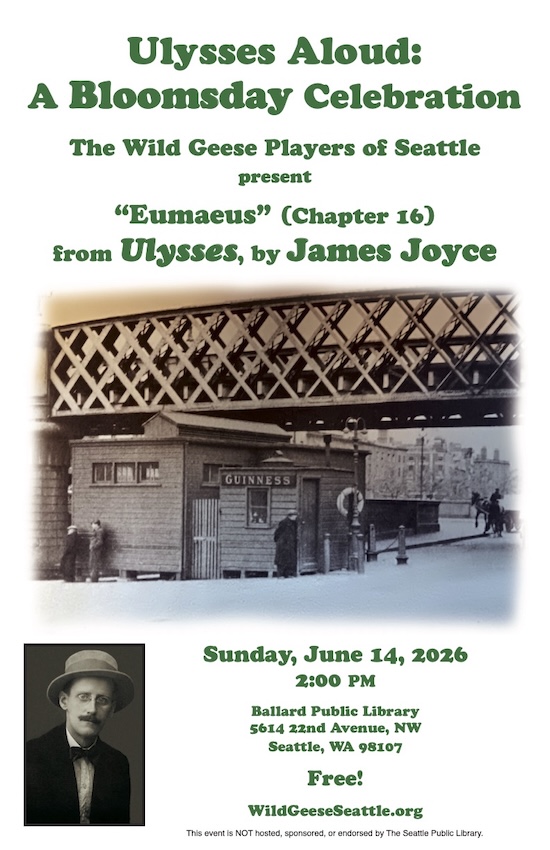
For our 29th annual staged reading,
the Wild Geese Players of Seattle
will present Episode 16, “Eumaeus”,
adapted from the 1922 edition of James Joyce’s Ulysses.
2:00pm on Sunday, June 14, 2026
Ballard Branch
of the Seattle Public Library,
5614 22nd Ave NW,
Seattle, WA 98107.
Bloomsday (Bloom’s day, named for Ulysses’ main character, Leopold Bloom)
refers to the 24-hour period on June 16, 1904
in which Ulysses is set.
Joyce’s ground-breaking novel follows the wanderings of Bloom, a Jewish everyman,
and Stephen Dedalus, a young writer and Joyce’s alter ego,
as they wander the streets of Dublin.
In Episode 16, it is about 1am on June 17.
Mr Bloom and Stephen Dedalus make their way to a cabman’s shelter to get a cup of coffee.
The shelter has a handful of motley inhabitants,
including the keeper, one Skin-the-Goat Fitzharris,
and D.B. Murphy, an old sailor and unreliable spinner of tales.
RSVP at the Facebook Event.
The meaning of Eumaeus
The structure of James Joyce’s Ulysses is loosely based on Homer’s Odyssey,
in which the hero Odysseus wandered around the ancient Mediterranean for decades
longing to get home to his wife, Penelope, and son, Telemachus.
Joyce’s Odysseus/Ulysses is Leopold Bloom, a slightly pathetic jewish Everyman
wandering around his native Dublin on June 16th 1904.
He feels bad because his wife Molly is being unfaithful and
their marriage has been sexless for many years,
since their baby son Rudy died.
Over the last couple of episodes,
Bloom felt protective and fatherly towards Stephen Dedalus, the son of a friend.
In the Odyssey,
Odysseus returns incognito to Ithaca,
disguises himself as a beggar,
and goes to the hut of Eumaeus, his swineherd,
and hears tall tales about himself.
Later, he reunites with Telemachus.
Bloom and Stephen are together in this episode,
but not of one mind.
Bloom hopes to make something of this chance meeting with Stephen,
who shows great promise.
Stephen, meanwhile, has his own abstruse concerns.
Commentary on Eumaeus
Click to read and post comments
posted
Apr 20, 2025
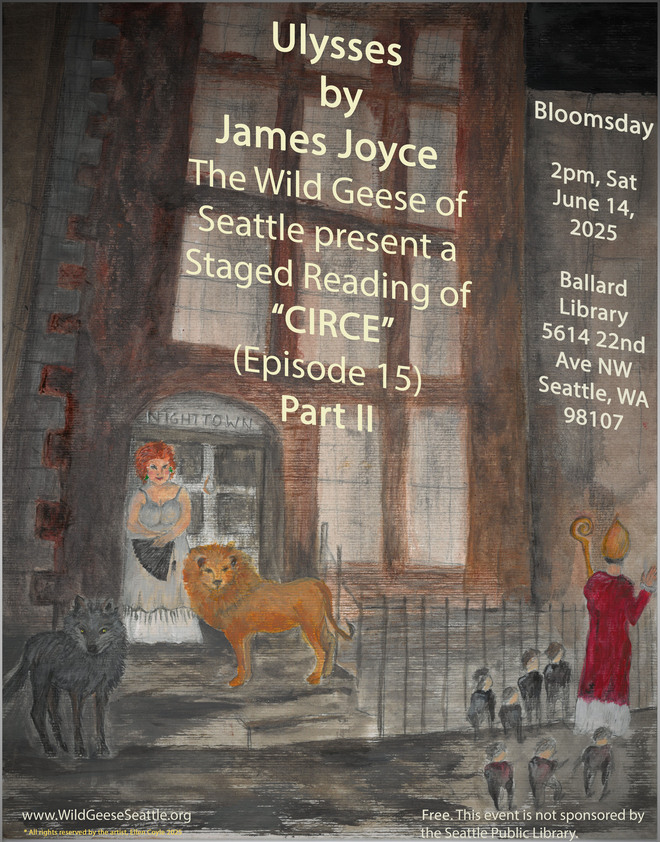
For our 28th annual staged reading,
the Wild Geese Players of Seattle
will present Episode 15, “Circe” (part II),
adapted from the 1922 edition of James Joyce’s Ulysses.
2:00pm on Saturday, June 14, 2025
Ballard Branch
of the Seattle Public Library,
5614 22nd Ave NW,
Seattle, WA 98107.
Bloomsday (Bloom’s day, named for Ulysses’ main character, Leopold Bloom)
refers to the 24-hour period on June 16, 1904
in which Ulysses is set.
Joyce’s ground-breaking novel follows the wanderings of Bloom, a Jewish everyman,
and Stephen Dedalus, a young writer and Joyce’s alter ego,
as they wander the streets of Dublin.
In Episode 15, it is around midnight,
and Stephen Dedalus and his friend Lynch, both very drunk,
have entered Nighttown, Dublin’s red-light district,
in search of female companionship.
Leopold Bloom, who has some paternal feelings for Stephen,
has followed them.
This chapter is full of hallucinations and nightmares,
where Bloom confronts many of his unspoken desires
and emerges strengthened.
The Circe episode is enormously long.
We are reading the second half this year,
having read the first half last year.
Note: this chapter is intended for an adult audience.
Bloom will be excoriated and sexually humiliated by the brothel’s madam.
RSVP at the Facebook Event.
The meaning of Circe
The structure of James Joyce’s Ulysses is loosely based on Homer’s Odyssey,
in which the hero Odysseus wandered around the ancient Mediterranean for decades
longing to get home to his wife Penelope.
Joyce’s Odysseus/Ulysses is Leopold Bloom, a slightly pathetic jewish Everyman
wandering around his native Dublin on June 16th 1904.
He feels bad because his wife Molly is being unfaithful and
their marriage has been sexless for many years,
since their baby son Rudy died.
At the end of the previous episode, Oxen of the Sun,
Bloom felt protective and fatherly towards Stephen Dedalus, the son of a friend.
In Homer’s Circe episode,
Odysseus maintains his wits and uses
the herb moly,
as advised by the god Hermes,
to avoid being unmanned
during his seduction by the goddess Circe
who has enticed his men with song and feasting
before transforming them into pigs.
She falls in love with Odysseus, reverses the spell on his men
and they feast for a year before she helps them on their way home.
The Circe story above inspires Joyce’s schema for his chapter,
which includes magic, whore, hallucination, man-hating ogress, and personification.
A major theme is that sexuality degrades men to the level of dumb unconscious swine…
note the multiple references to pigs.
The Homeric transformation to pigs may actually refer to anticholinergic intoxication,
producing amnesia, hallucinations, and delusions, and counteracted by the snowdrop flower,
fitting the description of moly.
There are some references to Bloom being womanly,
hinting at the overt gender transformations in the second half of the chapter.
Joyce’s usual multitude of voices are relatively easy to discern
because the text is written like a play,
though depiction of the many hallucinatory sequences and extreme transformations
would require ultramodern animation techniques.
Commentary on Circe
Click to read and post comments
posted
Oct 14, 2024
The Wild Geese Players of Seattle present
Readings for Samhain.
Spooks and ghouls and hauntings from Celtic and other writers!
Pour a brew and get ready to shiver your timbers!
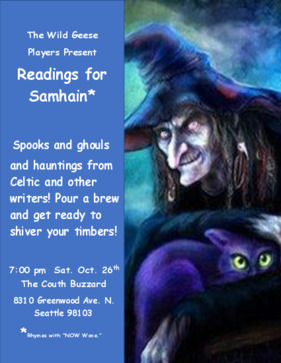
Sat, Oct 26, 2024, at 7pm
The Couth Buzzard,
8310 Greenwood Ave N,
Seattle, WA 98103.
RSVP at the Facebook Event.
Click to read and post comments
posted
May 13, 2024
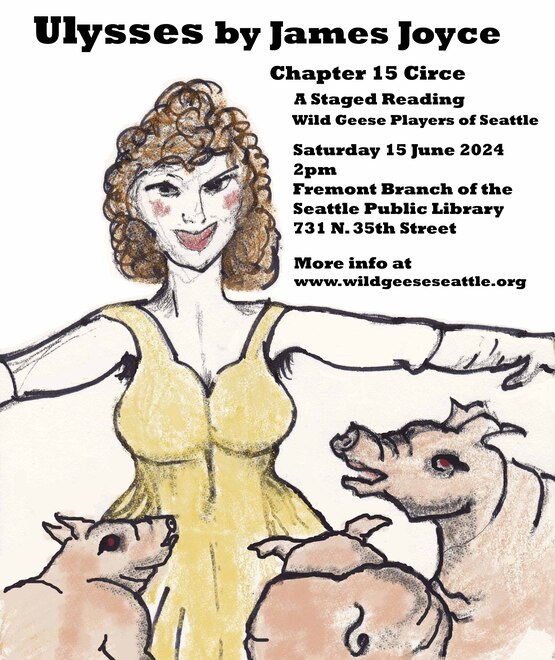
The Wild Geese Players of Seattle will present a staged reading of
Episode 15, “Circe” (part 1),
adapted from the 1922 edition of James Joyce’s Ulysses.
Two years ago marked the centenary of the publication of Ulysses in 1922.
For our 27th annual reading,
we’ll present Episode 15, “Circe” (part 1),
at 2:00pm on Saturday, June 15, 2024 at the
Fremont Branch
of the Seattle Public Library,
731 N. 35th St,
Seattle, WA 98103.
Bloomsday (Bloom’s day, named for Ulysses’ main character, Leopold Bloom)
refers to the 24-hour period on June 16, 1904
in which Ulysses is set.
Joyce’s ground-breaking novel follows the wanderings of Bloom, a Jewish everyman,
and Stephen Dedalus, a young writer and Joyce’s alter ego,
as they wander the streets of Dublin.
In Episode 15, it is around midnight,
and Stephen Dedalus and his friend Lynch, both very drunk,
have entered Nighttown, Dublin’s red-light district,
in search of female companionship.
Leopold Bloom, who has some paternal feelings for Stephen,
has followed them.
This chapter is full of hallucinations and nightmares,
where Bloom confronts many of his unspoken desires
and emerges strengthened.
This chapter is enormously long.
We’ll read the first half this year
and the second half in 2025.
RSVP at the Facebook Event.
Script
Read along with the script.
Adapted by George Reilly from the
Project Gutenberg text.
Commentary on Circe
Click to read and post comments